English
 English
 Español
 Tiếng Việt



Choosing a sieve shaker is not simply a matter of finding a machine that fits your test sieves. The movement of the machine, the characteristics of the material and the way the test is performed all affect the final result.
For laboratories and production facilities working with dry powders or granules, a horizontal sieve shaker can offer a practical way to perform particle-size classification, incoming-material inspection and routine quality control. This guide explains how horizontal sieving works, where it is most useful and what to check before selecting a machine.
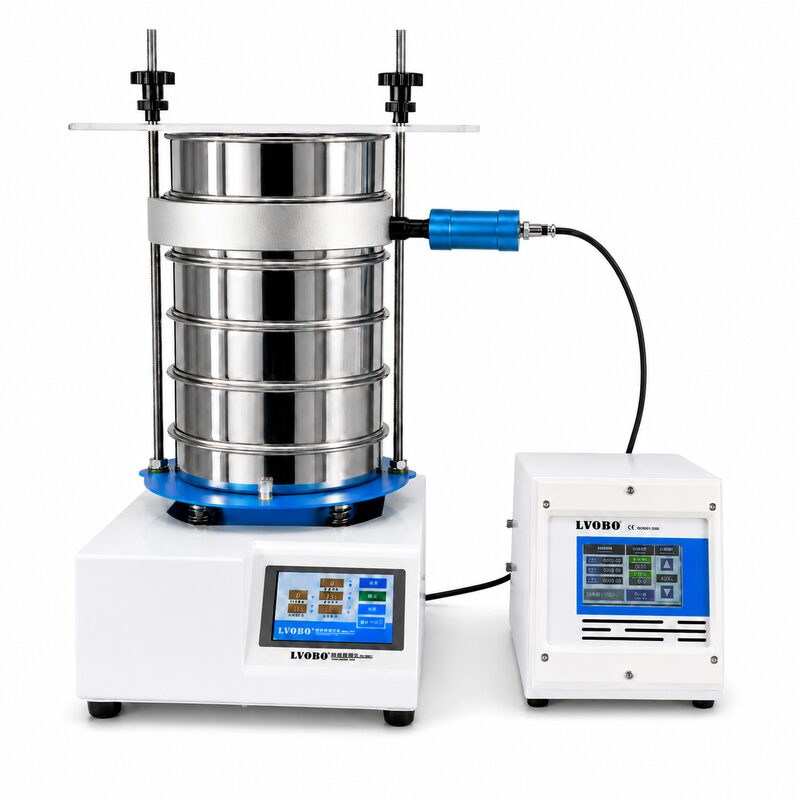
A horizontal sieve shaker moves a stack of test sieves in a circular path on a horizontal plane. As the material travels across the mesh surface, smaller particles pass through the openings while larger particles remain on the appropriate sieve.
This movement is different from the strong vertical impact or tapping action used by some other laboratory sieve shakers. Horizontal motion keeps the sample moving across the available screening area and can be useful when the material needs steady distribution rather than aggressive bouncing.
Some buyers search for this type of equipment as a “horizontal vibrating screen.” For laboratory particle-size testing, however, “horizontal sieve shaker” is usually the more accurate term.
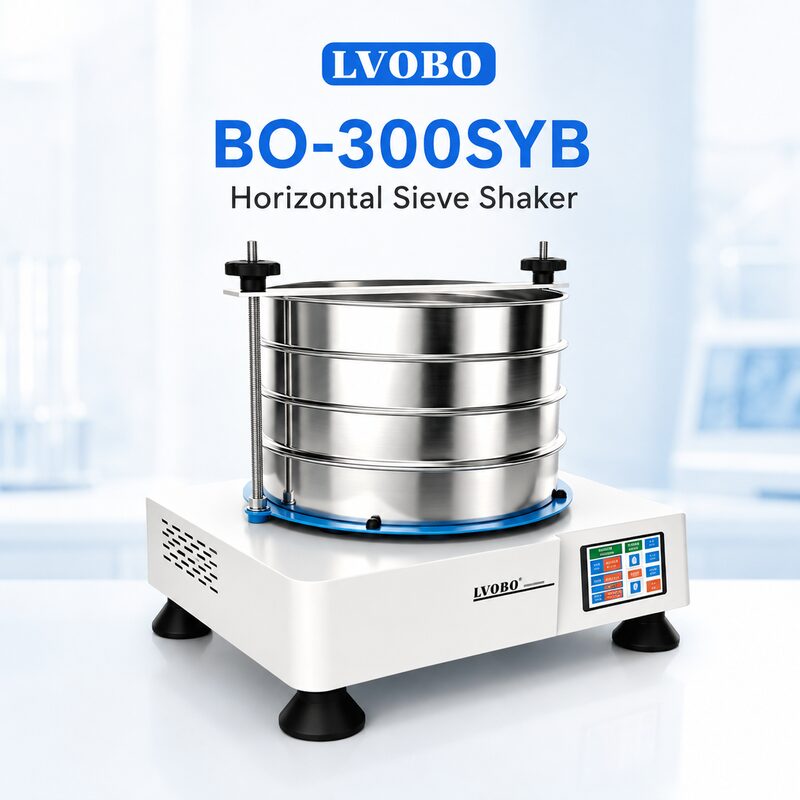
The BO-300SYB, for example, uses a 50 mm horizontal circular path. Its speed can be adjusted from 30 to 290 rpm, allowing the operator to change the movement according to the material and test conditions.
Horizontal sieve shakers are mainly used for dry materials that can move freely across a test sieve. Typical examples include:
Chemical powders
Pharmaceutical raw materials
Food powders and flour
Plastic granules
Ceramic powders
Metal powders
Mineral samples
Battery and other new-material powders
Being listed here does not automatically mean that every sample will screen easily. Moisture, static electricity, particle shape, bulk density and the tendency to agglomerate can all affect performance.
A dry, free-flowing granule may separate quickly, while a very fine or cohesive powder can take longer or require additional assistance. Material testing is therefore useful when the screening behavior is uncertain.
Start by confirming the diameter of the test sieves you already use or plan to purchase. Common laboratory sizes include 200 mm and 300 mm.
A 200 mm sieve is compact and suitable for many routine laboratory samples. A 300 mm sieve provides a larger screening area and may be more convenient for bigger samples or lower-density materials.
The BO-300SYB supports both 200 mm and 300 mm test sieves. However, sieve compatibility should never be judged by diameter alone. The frame height and clamping arrangement must also fit the machine.
Check how many size fractions must be collected in one test. Each additional test sieve represents another particle-size interval.
The BO-300SYB can hold up to three test sieve frames, with a collection pan underneath and a lid on top. The collection pan and lid are not counted as test sieve layers.
This distinction matters. A product page that says “three layers” may refer to three test sieves, or it may include the pan in that number. Ask the supplier to confirm the exact stack arrangement before ordering.
The recommended range for this machine is 8–200 mesh, but mesh number alone is not always enough to identify a sieve.
Mesh designations can vary according to the wire diameter and the test sieve standard being used. When accuracy matters, specify the required aperture size in millimeters or micrometers as well as the mesh number.
It is also worth confirming whether the sieve frames and mesh are supplied with the machine. For the BO-300SYB, the standard package includes the main unit, one SUS304 collection pan and one SUS304 lid. Test sieves and screens are ordered separately.
Higher speed does not always produce a better result. If the speed is too low, the sample may not travel across the entire mesh surface. If it is too high, particles may bounce, build up near the frame or fail to approach the openings effectively.
A speed range of 30–290 rpm provides room for adjustment. The best setting depends on particle size, density, sample quantity and flow behavior.
A practical approach is to begin with a moderate speed, inspect the material distribution and adjust the setting gradually. Once a suitable method has been found, it should be recorded and reused for future tests.
Programmable control is useful when the same materials are tested regularly. It reduces repeated setup work and helps operators follow a consistent procedure.
The BO-300SYB can store up to 12 operating programs. A cycle may include forward movement, a pause and reverse movement, while the timer can be set from 0 to 9999 minutes.
These settings can help redistribute material that tends to collect in one area. More importantly, stored programs make it easier to repeat an established test method across different batches or shifts.
Very fine powders may block sieve openings because of static charge, surface moisture or particle agglomeration. Increasing the speed or extending the test time will not always solve the problem.
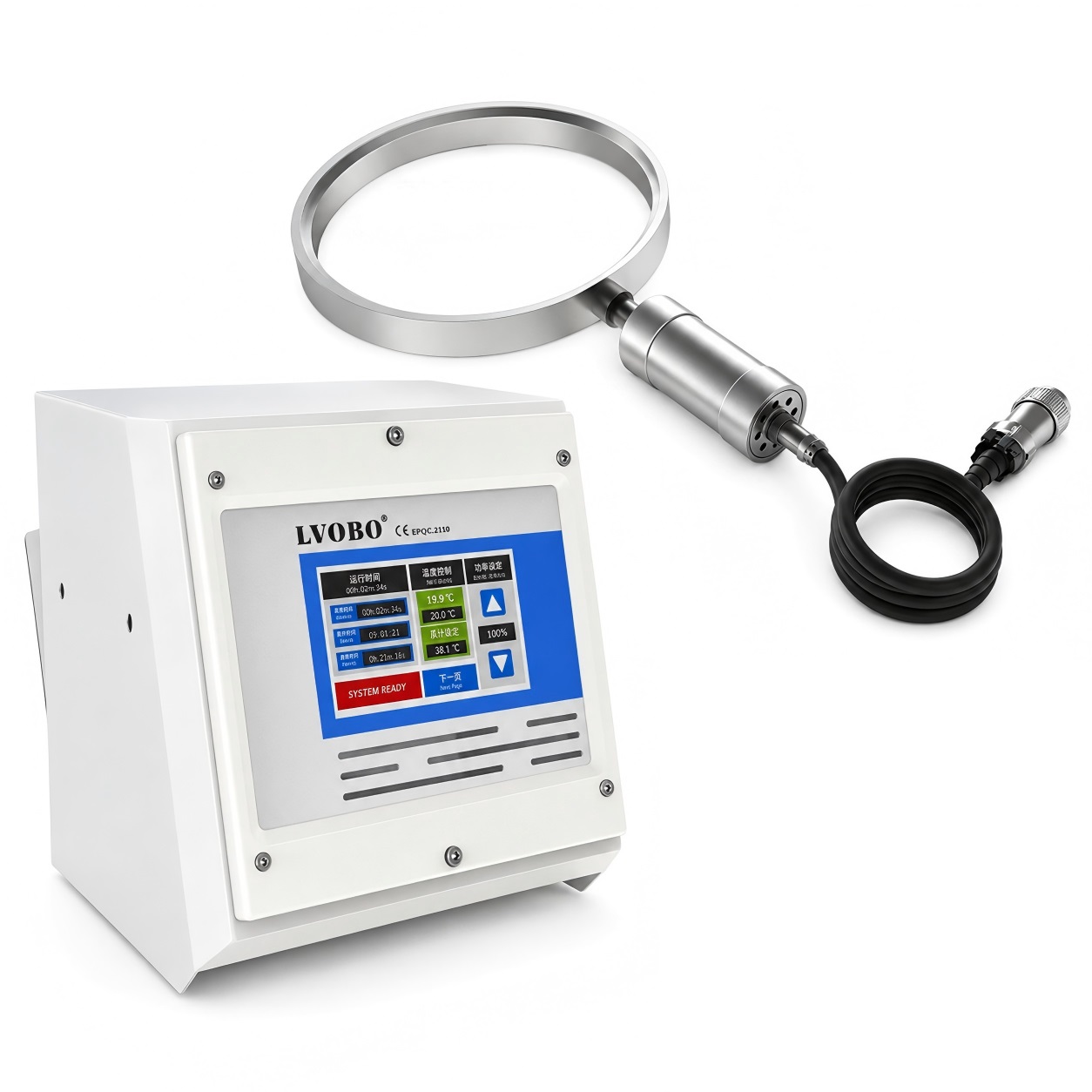
For selected fine or difficult-to-screen materials, optional ultrasonic sieving assistance may be considered. The ultrasonic system is sold separately and should be selected according to the material, sieve specification and testing objective.
Ultrasonic assistance is not automatically necessary for every fine powder. A sample test should be carried out before adding this option.
Voltage, frequency and plug type should be confirmed before shipment. A machine described as suitable for global markets does not necessarily have an automatic wide-voltage power supply.
For the BO-300SYB, the electrical configuration is prepared according to the destination market. Buyers should provide the required voltage, frequency and plug type when requesting a quotation.
Even a well-selected laboratory sieve shaker cannot compensate for an inconsistent test method. For comparable results, keep the following conditions under control:
Use the same sample mass for repeated tests.
Make sure the sample is dry and properly prepared.
Clean the mesh without damaging or enlarging its openings.
Avoid overloading the sieve surface.
Keep the speed, time and movement program consistent.
Record the sieve aperture, retained mass and test conditions.
Inspect sieve frames and mesh regularly for wear or deformation.
The required screening time should be established through testing. One useful method is to continue sieving in short intervals. If the retained mass changes very little during the additional interval, the separation may be considered complete for that method.
One common mistake is selecting a machine only by its finest advertised mesh. Fine-powder performance depends on more than the mesh number. Material behavior, sample load, static electricity and cleaning method can be just as important.
Another mistake is assuming a fixed processing capacity. Laboratory sieve shakers do not have one universal capacity for all products. A dense mineral sample and a lightweight food powder can behave very differently, even when the same sieve is used.
Buyers should also avoid assuming that test sieves, ultrasonic components or electrical customization are included in the base price. A complete quotation should clearly separate the standard package from optional items.
Before choosing a horizontal sieve shaker, prepare the following information:
Material name and physical characteristics
Target particle-size range
Required aperture or mesh sizes
Expected sample quantity
Preferred sieve diameter
Number of test sieve frames
Voltage, frequency and plug type
Need for ultrasonic assistance
Required interface language or branding
Frequency of testing and need for stored programs
Providing this information allows the supplier to recommend a more suitable configuration and identify potential screening problems before the machine is shipped.
A horizontal sieve shaker is a useful tool for repeatable dry particle-size analysis, but its effectiveness depends on matching the machine to the sample and the test method.
Sieve diameter, stack capacity, mesh aperture, speed range and programmable control should all be evaluated together. For very fine or cohesive powders, a material test is often more valuable than relying on specifications alone.
The BO-300SYB is one option for users who need 200 mm or 300 mm test sieves, up to three sieve frames and programmable horizontal movement. Whether it is the right choice ultimately depends on the material, required separation range and testing procedure. Sharing a representative sample with the supplier before ordering can reduce uncertainty and make the final selection more reliable.
 3rd Floor, Building 8, Licheng Science and Technology Innovation Center, No. 188 Taixin Street, Licheng District, Quanzhou City, Fujian Province, China
 Tel : +86 -13788824251
 Email : lvobo2026@gmail.com,Ivobo2088@gmail.com
 WhatsApp : +86 -13788824251


Our hours
Monday - Saturday: 8:00 AM - 6:00 PM
 IPv6 Network Supported